

Meeting Jews in Germany
10/07/2023
Jews make up only 0.2% of the population in Germany. Since most people in Germany don’t have personal interactions with Jews as a result, their knowledge about modern Jewish life is not based on real-life experiences.
“Meet a Jew” is a project of the Central Council of Jews in Germany under the patronage of the Federal President of Germany, Frank-Walter Steinmeier and supported by the “Live Democracy!” program of the German Federal Ministry for Family Affairs, Senior Citizens, Women and Youth. Launched in 2020, the initiative travels throughout the country to introduce Jews and Judaism to non-Jewish people. Over 450 volunteers regularly visit schools, universities, sports clubs, and other groups to talk about their daily life, their Jewish identity, and answer questions about Jewish life in Germany today. By meeting people face-to-face, they aim to debunk stereotypes about Jews, replacing them with actual experiences. During the pandemic, many of the encounters occurred online.
The initiative comes at a sensitive time, as antisemitic incidents have been increasing across Germany over the last years. In 2019, a far-right shooter tried to break into the Halle synagogue on Yom Kippur while worshippers were inside. During the coronavirus pandemic, anti-vaccine and other conspiracy myths often intertwined with anti-Jewish stereotypes.
“Being a minority in Europe and having the awareness of the Shoah, Jews understand and value the importance of fundamental democratic rights such as freedom of religion, freedom of expression, and the protection of minorities,” Dr. Josef Schuster, President of the Central Council of Jews in Germany and Vice-President of the World Jewish Congress, explained to the NOA project.
“Jewish volunteers with Meet a Jew therefore see their involvement not only as a service to the Jewish community, but as a contribution to Germany’s and Europe’s societies as a whole. They are sensitive to antidemocratic developments, which try to attack the core values of free societies and often come along with conspiracy theories and antisemitic tropes.”
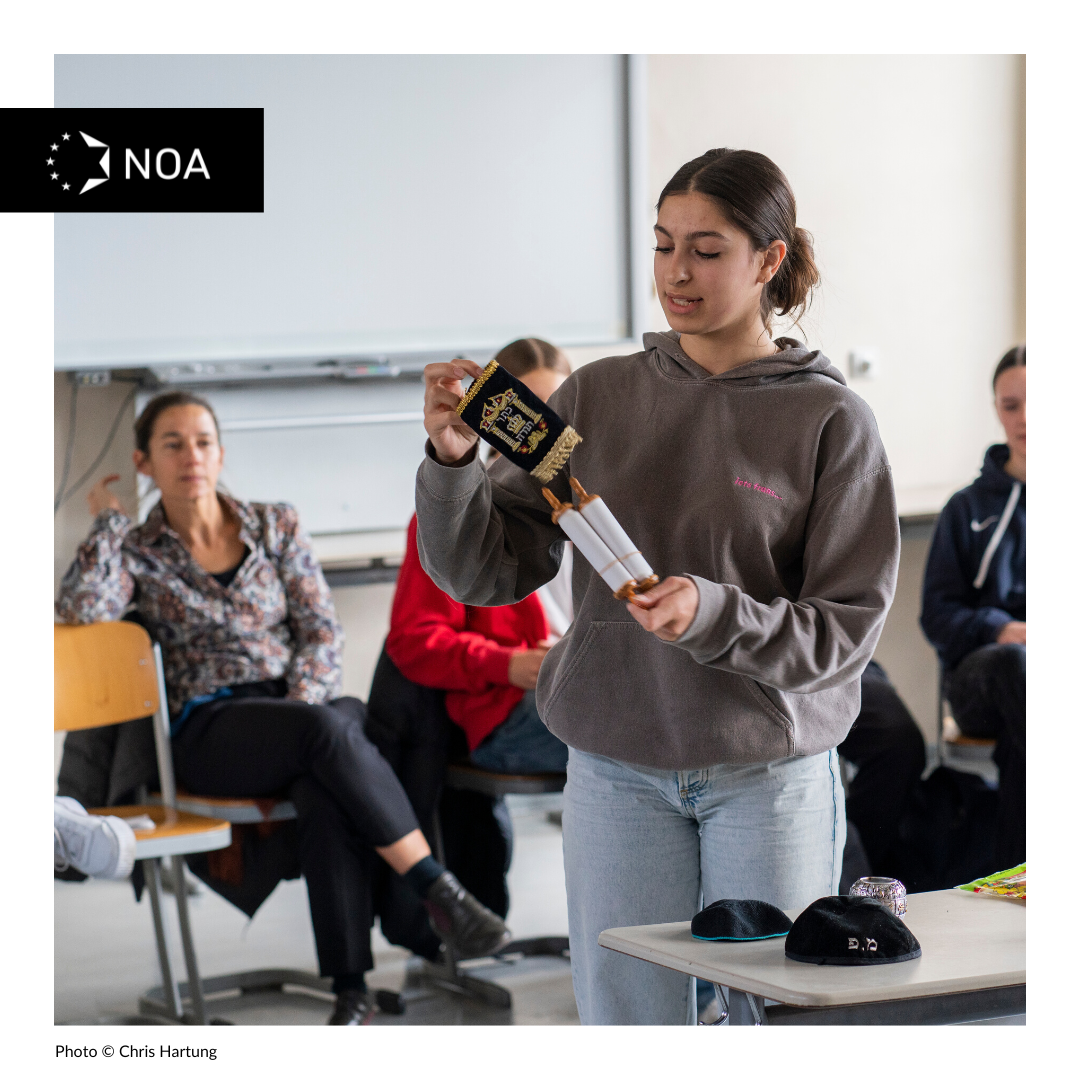
Jewish volunteers with Meet a Jew encourage dialogue, introduce Jewish people as individuals in contrast to abstract and generalizing representations of Jews as a presumably homogenous group, and help debunk stereotypes. They also strive toward building allyships between different minority groups and encourage young people to speak up. “My motivation [is] that we can finally start focusing on what unites us,” Alexandra, one of the young volunteers relates. “Instead of frantically searching for what makes us different.”
For more information please visit www.meetajew.de.
A NOA profile on Jews creating a more inclusive Europe www.noa-project.eu
Curating tolerance: Insights from the POLIN Museum of the History of Polish Jews
28/02/2023
Opened in 2013, the POLIN Museum of the History of Polish Jews in Warsaw offers a throve of knowledge about the rich history of Jewish life in Poland. Located in what used to be the heart of the Warsaw Ghetto during Nazi Germany’s occupation of Poland, the POLIN Museum is one of the most important institutions in the field of Jewish history in Europe today.
Fewer than 10,000 Jews live in Poland today, yet before the Holocaust the country was home to one of the largest Jewish populations in the world. The NOA project spoke with Joanna Fikus, the Head of the Exhibitions department of the POLIN Museum, about their work showcasing 1,000 years of Polish Jewish history, while at the same time building a more tolerant society.
NOA: How do you decide where to begin telling the story of 1,000 years of Jewish history in Poland?
JK: We decided to tell this history from a specific perspective – from the perspective of Jews living in each time period. We chose to show it in a way that would make our visitors feel as though they were in the same position of Jews back then, to imagine you have the knowledge limited to that very specific time period, to identify with the individual persons.
With our temporary exhibitions we do it differently. Every time we choose a subject, we are trying to find something universal about the experience. In an exhibition about the antisemitic campaign of March 1968, we thought: How can we make this relevant to a young person today? Step by step we created the essence of our message: How would you feel if someone came to you and told you that you are a stranger in your own home, your own country, that you don’t belong here? In March 1968 Jews were simply told they don’t belong in Poland. And there are many other cases in the world where people are forced to leave as refugees. Unfortunately, it’s a common experience.
NOA: What has changed in Polish society in the last 10 years since the POLIN museum opened?
JK: In the first years of the museum’s operation, our focus was really to bring back the history of Jews in Poland, because this history was quite unknown among young Polish audiences. After several years we decided to be more ambitious. Why do we want to recall the history of Polish Jews? To counter antisemitism, discrimination, and exclusion by creating mutual understanding and respect.
Some people were afraid to come here. Afraid to deal with a difficult subject, they were not ready to be confronted with it. As a result, we have diverse activities for them: Musical concerts, educational programs for kids and parents. We want them to come here and see this is not only a museum talking about the Holocaust. Once we bring them in and make them more familiar, and willing, and open, then it’s easier to discuss the difficult topics.
NOA: What has surprised you the most?
JK: I didn’t expect how many people would be interested in the subject that we are dealing with. In Poland with this current political situation, it is difficult. We are not open to blunt conversations about dark and bright moments in our history. It’s hard to change the mindset of other people. But we thought, who will do this if not us?
NOA: Did the war in Ukraine bring changes for the museum?
JK: Of course. There was a huge wave of Ukrainian refugees who came to Poland and to Warsaw. We had to adjust our program and activities to their needs, to Ukrainian women and children. Many of them are traumatized. We wanted to show them this is a safe place.
This place is also about their story, about them. Historically, much of the story of Polish Jews happened on the historical territory of Ukraine.
You cannot change the past. The only thing that we can change, step by step, is the present moment. Each one of us can do it by being careful and thoughtful of the people around you. You don’t need big gestures. You simply must keep your eyes open, look not to hurt others, and help them. That’s the main lessons of this war in Ukraine.
–
A NOA profile on Jews creating a more inclusive Europe. www.noa-project.eu
INACH – International Network Against Cyber-Hate
27/10/2021
| INACH unites organizations around the world, incorporating different cultural backgrounds and speaking many languages. It has a diverse perspective, allowing the network to counter and address all forms of online discrimination. INACH adds value to the Internet and brings the online in line with Human Rights. |
INACH – International Network Against Cyber-Hate
27/10/2021
INACH unites organizations around the world, incorporating different cultural backgrounds and speaking many languages. It has a diverse perspective, allowing the network to counter and address all forms of online discrimination. INACH adds value to the Internet and brings the online in line with Human Rights.
 NOA is co-funded by the European Union’s Citizens, Equality, Rights and Values Programme (2021-2027).