

Building Safety Together: One Year of NOA-2’s Train-the-Trainers Programme
16/02/2026
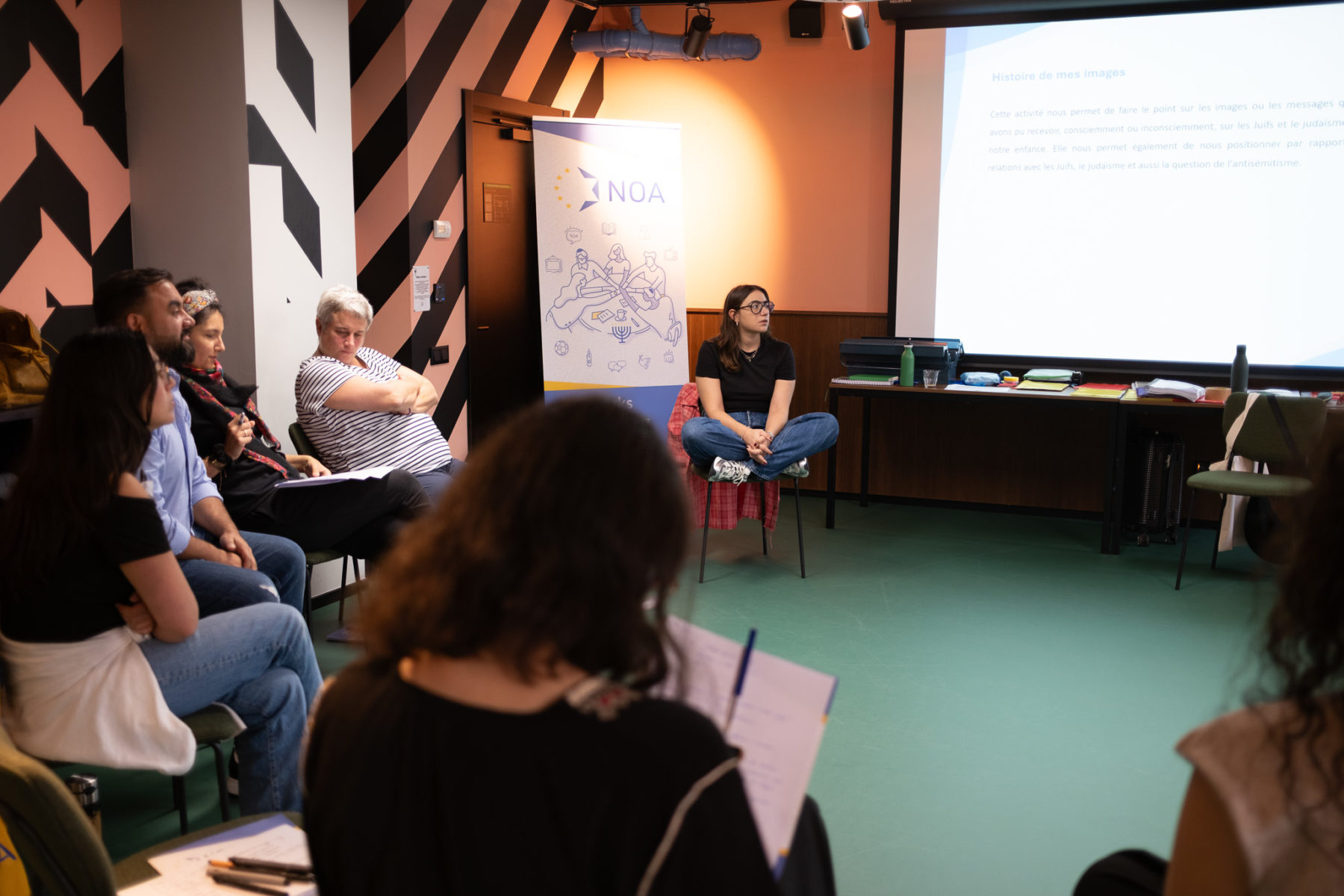
Participants sit in a circle while the facilitator presents next to a projects during the NOA Train-the-Trainers Programme.
Fostering Jewish life in Europe requires more than celebration and visibility. It depends on creating conditions of safety, trust, and shared responsibility. Antisemitism cannot be addressed by Jewish communities alone; it calls for a whole-of-society approach in which institutions, professionals and citizens act together. One year after the launch of NOA-2’s Train-the-Trainers (TTT) programme, this principle remains at the heart of our work.
Many key moments in Jewish history would not have been possible had it not been for a partnership beyond the Jewish community itself. In the Torah, Yitro (Moses’ father-in-law and a non-Jewish ally) offers guidance that strengthens leadership and enables the community to endure. In the Tanakh, the Persian emperor Cyrus created the conditions for Jews to return to the land of Israel after the Babylonian exile and promoted a culture of tolerance. In more recent history, the Righteous Among the Nations offered protection at the darkest of times. Again and again, the same lesson emerges: Jewish life thrives when wider society acts as a partner.
It is this insight that underpins NOA’s Train-the-Trainers programme. Since February last year, the programme—led by CEJI—has trained two cohorts (English- and French-speaking) of 24 educators from eight European countries. Participants strengthened their capacity to address antisemitism across sectors including education, youth work, civil society, sports, interfaith spaces, and public authorities, using structured anti-bias pedagogical methods designed to respond to evolving challenges.
As one participant reflected, “The training created an open and safe space to challenge my own biases before addressing those of others.” Another highlighted “a serious, innovative and deeply human approach that continues to shape my professional practice.” A third shared how the programme has already enabled them to train police students, noting the methods are “versatile, engaging, and thought-provoking.”
These voices reflect what the Guidelines for Fostering Jewish Life emphasise: safety is not abstract. It is built through education, cooperation, and sustained engagement across society. One year on, NOA’s Train-the-Trainers programme stands as a concrete tool for translating this shared responsibility into action.
 NOA is co-funded by the European Union’s Citizens, Equality, Rights and Values Programme (2021-2027).